
What to Expect on Your First Court Date in Cobb County
Your first court date in Cobb County is mostly waiting — but it sets the tone for your whole case. Where to park, which building, what happens at arraignment, and the mistakes to avoid.
Your first court date in Cobb County will probably be nothing like TV. There’s no dramatic testimony and, in most cases, no decision about guilt. It’s mostly waiting, listening for your name, and answering a few questions. But it’s also the day that sets the tone for everything that follows — and the day people are most likely to make an avoidable mistake. Here’s what to expect, from parking to walking out.
Before you leave the house
Pull out every piece of paper you were handed: the citation or bond paperwork, the court notice, and anything from the jail. Confirm three things on it: the date, the time, and the courtroom or building. Cobb County has several courts sitting on two downtown blocks, and going to the wrong one can cost you the morning.
- State Court handles most misdemeanors and traffic offenses, including many DUIs.
- Superior Court handles felonies.
- Magistrate Court handles first appearances, warrants and preliminary matters.
Bring a government-issued photo ID, your paperwork, and a pen. Dress the way you’d dress for a job interview at a bank — no shorts, tank tops, hats or slogans. Judges notice, and so do prosecutors.
One more thing before you go: if you’ve moved since your arrest, make sure the clerk has your current address. The court mails notices to the address on file, and a notice you never received can still turn into a bench warrant.
Parking and getting inside
Give yourself 30 to 45 minutes more than you think you need. Monday mornings are the busiest, and security lines back up.
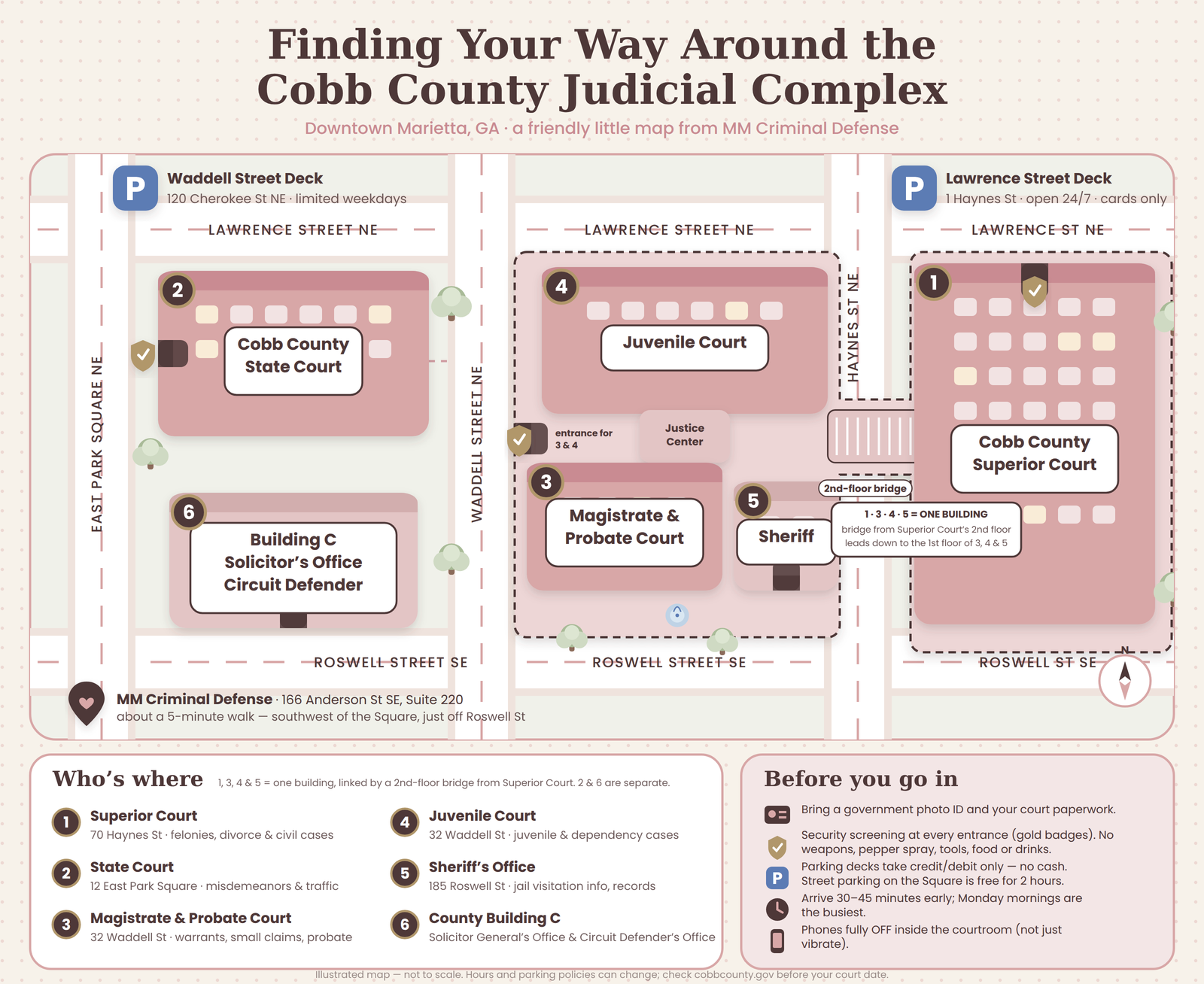
The Lawrence Street Deck (1 Haynes St) is closest to Superior Court and open around the clock; the Waddell Street Deck (120 Cherokee St NE) is closer to State Court but has limited weekday access. Both take cards only. Street parking around Marietta Square is free for two hours, which is fine for a quick calendar call but risky if your hearing runs long.
Every building has a security checkpoint, and they’re not all where you’d expect: State Court’s entrance is on East Park Square, Superior Court’s is on Lawrence Street, and Juvenile and Magistrate/Probate share one entrance on Waddell Street. Leave pocket knives, pepper spray, tools, food and drinks in the car. We put all of this on one page — our illustrated Cobb County courthouse map — so you can find your building, the parking decks and the right door at a glance.
What actually happens in the courtroom
For most people, the first date is an arraignment or calendar call. You’ll find your courtroom, check in with the bailiff or the clerk if they’re taking names, and sit down. Then you wait. Dozens of cases are usually set for the same time, and the judge works through them in whatever order the court uses that day.
When your name is called, you’ll step forward. At arraignment the judge (or the prosecutor, in some courtrooms) reads the charges and asks how you plead. If you already have a lawyer, we can often waive formal arraignment in writing ahead of time, which may mean you don’t have to appear at all for that setting, or that your appearance is brief.
A few ground rules that matter more than people realize:
- Phone completely off. Not vibrate. Off.
- Stand when the judge enters and when you’re addressed. Answer “Yes, Your Honor” and “No, Your Honor.”
- Don’t talk about the facts of your case with the prosecutor, the officer, or anyone in the hallway. Anything you say can be used later. “I’d like to speak with a lawyer first” is a complete sentence.
- Don’t sign anything you don’t understand. A quick plea to “get it over with” can carry consequences — license suspension, immigration issues, a permanent record — that no one explains in the moment.
Will my case be decided that day?
Almost never. The first date exists to formally begin the case and set the next steps: a plea, a discovery deadline, a motions date, or a trial calendar. Some misdemeanor and traffic cases do resolve early through negotiation, but that’s a decision to make with a lawyer who has actually seen the State’s evidence — not one to make in a hallway ten minutes after your name is called.
What if I can’t be there?
Call before the date, not after. If you have a genuine conflict — a medical emergency, a death in the family — a lawyer can often request a continuance. Simply not showing up is the worst option available. In Georgia, a missed court date can result in a bench warrant for your arrest and, in traffic cases, a license suspension. If you’ve already missed one, don’t wait for it to sort itself out; call us and we’ll talk through how to get it lifted.
How having a lawyer changes the day
Walking in with counsel changes almost everything about a first court date. We handle the check-in and the conversation with the prosecutor. We know which courtrooms move fast and which judges have particular expectations. We can often waive arraignment so you don’t lose a workday, and we make sure nothing gets decided before we’ve reviewed the evidence. Because both of our attorneys prosecuted in these courtrooms before switching sides, we also know what the State is likely thinking — and what it’s likely missing.
Getting representation early also tends to give you more options, including payment plans on many cases; the longer a case sits, the fewer choices you have.
Your court-day checklist
- Photo ID and every piece of court paperwork
- Correct building and courtroom confirmed (check the map)
- Card for the parking deck — no cash accepted
- Business-casual clothes; nothing with a message on it
- Arrive 30–45 minutes early
- Phone off before you walk into the courtroom
- No discussion of your case with anyone but your lawyer
Have a court date coming up in Cobb County?
Call MM Criminal Defense at 770-693-4357 or request a free consultation. The earlier we’re involved, the more we can do — and we can often handle that first appearance so you don’t have to.
This article is general information about court procedure in Cobb County, Georgia, not legal advice about your case. Procedures vary by court and judge and can change. If you have a pending case, talk to a lawyer about your specific situation.