
How Bail Bonds Work in Georgia: A Plain-English Guide to Bonds and Bondsmen
Arrested in Cobb County? Here’s how bail bonds work in Georgia, what a bondsman charges, what happens if you miss court, and why calling a defense attorney early can save you money.
If someone you love has just been arrested in Cobb County or anywhere in Georgia, the first question is almost always the same: how do we get them out? The answer usually runs through a bond. Understanding how bonds work, what a bail bondsman actually does, and where a defense attorney fits in can save your family money, time, and a lot of stress in the first 72 hours.
This guide walks through the process in plain English. It is general information about Georgia law, not legal advice about your specific situation.
What Is a Bond, and Who Sets It?
A bond is a promise, backed by money or property, that a person will come back to court when ordered. The court holds that promise as security. Show up to every court date and the money or property is returned (minus any bondsman’s fee). Miss court and the court can keep it.
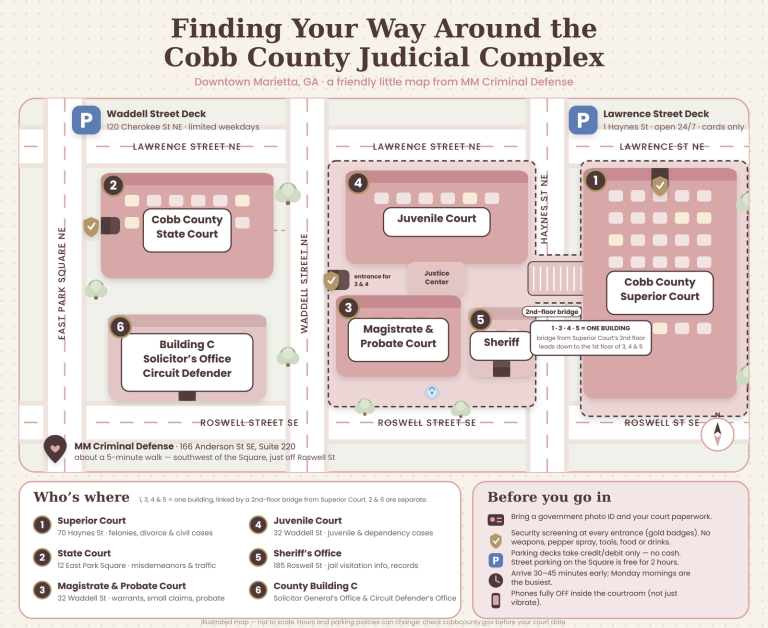
In Georgia, most people see a judge at a first appearance hearing within 72 hours of arrest (48 hours if the arrest was made without a warrant). In Cobb County, that hearing usually happens in Magistrate Court at the Adult Detention Center. For many offenses, the magistrate judge sets bond right there. Some counties also use a bond schedule, which is a preset amount for common misdemeanors that lets a person bond out before ever seeing a judge.
For the most serious felonies, such as murder, armed robbery, rape, and aggravated child molestation, only a Superior Court judge can set bond. That means no bond is set at first appearance, and a separate bond hearing has to be requested.
When deciding whether to grant bond and how much, Georgia judges look at four questions under O.C.G.A. § 17-6-1: Is the person a flight risk? A danger to the community? Likely to intimidate witnesses? Likely to commit another felony while out? Ties to the community, employment, family, and criminal history all factor into the answer.
The Types of Bonds in Georgia
Georgia courts can release someone on several kinds of bond. The judge decides which ones are allowed in a given case.
| Type of bond | How it works | What it costs you |
|---|---|---|
| Cash bond | You pay the full bond amount to the jail or court | Full amount up front, refunded when the case ends if all court dates are kept |
| Property bond | Equity in Georgia real estate is pledged as security | No cash, but a lien on the property and extra paperwork at the clerk’s office |
| Surety bond | A licensed bail bondsman posts the bond for you | A non-refundable fee to the bondsman, usually 10 to 15 percent of the bond |
| Own recognizance (OR) | Released on a signed promise to appear, no money posted | Nothing, but only available for certain offenses |
Since 2024, Georgia’s Senate Bill 63 requires a cash, property, or surety bond for a list of roughly 30 “bail-restricted” offenses, including some misdemeanors. For those charges, an OR bond is off the table, and a bondsman is often the only practical way home.
How a Bail Bondsman Works
A bail bondsman (also called a bonding company or surety) is a licensed business that promises the court the full bond amount on your behalf. If the judge sets a $10,000 bond and you cannot pay $10,000, the bondsman posts it for you in exchange for a fee.
The premium. The bondsman’s fee is a percentage of the bond, set by Georgia law and the county. In metro Atlanta it typically runs 10 to 15 percent. On a $10,000 bond, expect to pay roughly $1,000 to $1,500. This fee is the bondsman’s profit and is not refunded, even if the charges are dismissed the next day.
Collateral and co-signers. For larger bonds, the bondsman may ask for collateral such as a car title or a deed, or require a co-signer (often called an indemnitor). The co-signer agrees to be responsible for the full bond amount if the defendant disappears. Read that paperwork carefully before you sign it for a friend.
Check-ins and conditions. Many bonding companies require the defendant to check in regularly, keep a current address, and notify them of every court date. A bondsman who believes a client is about to run can surrender that client back to the jail and cancel the bond.
Who gets what back. When the case ends, the court releases the bond. With a surety bond, the bondsman gets released from the obligation and returns any collateral. The premium stays with the bondsman. With a cash bond, the person who posted the money gets it back from the clerk, though some courts deduct fines and fees first.
Bond Conditions and What Happens If You Miss Court
Bond is almost never just about money. Judges attach conditions, and breaking them can land you right back in jail. Common conditions in Georgia include no contact with the alleged victim, staying away from a specific address, no alcohol or drugs, random testing, an ankle monitor, or a curfew. In family violence cases, no-contact orders are nearly automatic.
Missing a court date triggers three things at once. The judge issues a bench warrant for your arrest. The court starts the process of forfeiting the bond, which means the cash, property, or bondsman’s money is at risk of being kept. And the bondsman, now on the hook for the full amount, will come looking for you, often with the help of a recovery agent.
Georgia gives the bondsman a window to bring the defendant back before the forfeiture becomes final. If you missed court by honest mistake, call your attorney immediately. A quick motion to lift the bench warrant and reinstate the bond is far easier than fixing things after an arrest.
What If Bond Is Denied or Set Too High?
A denied bond or a bond your family cannot afford is not the end of the road. A defense attorney can file a motion for bond or a motion to reduce bond and ask for a hearing. At that hearing, the attorney presents evidence on the four factors the judge must weigh: proof of employment, a stable address, family in the area, a clean or minimal record, and a plan for supervision. Letters from employers and family members often make a real difference.
Georgia law also gives defendants a powerful backstop. Under O.C.G.A. § 17-7-50, if a person is held in jail for 90 days without being indicted, they are entitled to a bond. Prosecutors do not always track that deadline. A defense attorney will.
Attorneys can also ask the judge to approve alternatives that lower the cash needed, such as a property bond, a lower amount paired with an ankle monitor, or a split between cash and surety.
Why Calling a Defense Attorney Early Matters
A bondsman gets you out of jail. A defense attorney protects what happens next. The two jobs are different, and the order you do them in matters more than most families realize.
An attorney who is involved before the first appearance can speak for you in front of the judge, push for a lower bond or an OR release, and make sure the conditions attached are ones you can actually live with. That can mean the difference between paying a bondsman $500 or $3,000. It also means every statement you make to police after the arrest has someone looking out for you.
Getting representation early also gives you more financial flexibility. Fees paid to a bondsman never come back. Money spent on your defense at the start of a case, before evidence goes stale and before deadlines pass, is money that works for you.
If you or a family member has been arrested in Cobb County or the surrounding metro Atlanta area, contact MM Criminal Defense in Marietta or call us at 770-693-4357. We can walk you through the bond process, appear with you at first appearance, and start building your defense from day one.
This article is for general informational purposes and does not create an attorney-client relationship. Bond rules and bondsman fees vary by county and change over time. Talk to an attorney about the facts of your case.