
How Do I Qualify for a Public Defender in Georgia?
Learn who qualifies for a public defender in Georgia, how income limits work, how to apply, and what to do if you don’t qualify or want your own lawyer.
If you’ve been arrested in Georgia and can’t afford a lawyer, you may be wondering whether you can get a public defender. The U.S. Constitution guarantees the right to an attorney when you are facing possible jail time, and Georgia provides public defenders for people who cannot afford to hire one.
But not everyone qualifies. Georgia uses specific income guidelines to decide who is eligible. This guide explains how the process works, what to expect when you apply, and what your options are if you don’t qualify.
Who Is Entitled to a Public Defender in Georgia?
You may be entitled to a court-appointed attorney if you are charged with a crime that could result in jail time and you are considered “indigent” under Georgia law. This applies to felonies, and it can also apply to misdemeanors, probation violations, and some city or county ordinance violations when jail is a possible punishment.
If the only possible penalty is a fine, you generally do not have a right to an appointed lawyer.
How Georgia Defines “Indigent”
Georgia’s Indigent Defense Act, found at O.C.G.A. § 17-12-2, sets income standards based on the federal poverty guidelines.
Misdemeanors and probation violations. A person charged with a misdemeanor, a probation violation, or a county or municipal offense punishable by jail generally qualifies if they earn less than 100 percent of the federal poverty guidelines.
Felonies. A person charged with a felony generally qualifies if they earn less than 150 percent of the federal poverty guidelines.
Juvenile cases. In juvenile delinquency cases, eligibility is based on the parents’ income, generally less than 125 percent of the federal poverty guidelines.
The income ceiling. No one whose income exceeds 150 percent of the federal poverty level can be considered indigent.
Even if your income falls below these limits, you may be denied if you have other resources that could reasonably be used to hire a lawyer without undue hardship to you or your dependents. That can include savings, property, or other assets.
The federal poverty guidelines are updated every year and depend on household size, so the exact income limit will vary.
How to Apply for a Public Defender
The application process varies by county, but it usually follows the same basic steps.
Fill out an application. You will complete a financial application or affidavit listing your income, household size, expenses, and assets. You sign it under oath, so it must be accurate.
Provide proof of income. Many offices ask for pay stubs, tax returns, Social Security statements, or proof of public benefits.
Pay the application fee. Georgia law requires a $50 application fee for people who apply for public defender services. In some situations the fee may be waived. Ask the office how it must be paid, since many do not accept personal checks.
Apply as early as possible. If you are in jail, you can often apply at your first appearance hearing or through the jail. If you are out on bond, contact the public defender’s office for your county before your first court date. Waiting until the day of court can delay your case.
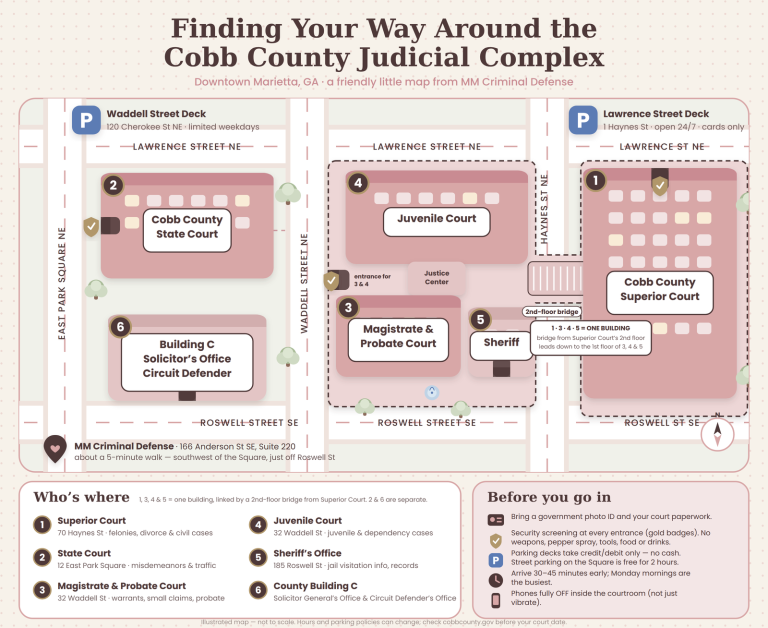
In Cobb County, the public defender’s office handles eligible cases in Superior Court and State Court. Misdemeanor cases in other courts, such as municipal or probate court, may have a separate process.
What If I Don’t Qualify?
Many working people earn too much to qualify for a public defender but still struggle to afford a private lawyer. If you are denied, you still have options.
Talk to a private attorney about payment plans. Many criminal defense firms offer payment plans. At MM Criminal Defense, we offer affordable payment plans when we can, especially when clients reach out early.
Don’t wait. The longer you wait, the more you risk missing important deadlines and losing defense options. Payment plans are also generally less available once a case has been pending for a while.
Don’t plead guilty just to get it over with. Without a lawyer, many people accept a plea at their first court date. That decision can leave you with a permanent record that might have been avoided.
Public Defender vs. Private Lawyer: What’s the Difference?
Public defenders are licensed attorneys, and many are dedicated and skilled advocates. The challenge is often caseload. Public defenders in Georgia frequently carry a large number of cases at once, which can limit how much time they can spend with each client.
With a private lawyer, you choose your attorney. You may also have more direct access to your lawyer, more time to discuss your case, and more control over who handles your defense from start to finish.
Can I Switch From a Public Defender to a Private Lawyer?
Yes. You can hire a private attorney at any point in your case. Your new lawyer will file an entry of appearance, and the public defender will withdraw. Switching early gives your new attorney the most time to review the evidence and build your defense.
Get Help From MM Criminal Defense
Whether you qualify for a public defender or not, you deserve a strong defense. If you’ve been charged with a crime in Cobb County or the surrounding metro Atlanta area, contact MM Criminal Defense to schedule a consultation. We will talk through your case, your options, and what representation would cost.
Our office is located at 166 Anderson St. SE, Suite 220, Marietta, GA 30060.
This article is for general information only and is not legal advice. Every case is different. Contact an attorney to discuss your specific situation.